A central server that bridges your hardware with JavaScript, dashboards, and AI. Write drivers in 20 lines. Automate your entire lab.
// control a power supply const psu = connector("psu"); psu.voltage = 12; // read a temperature sensor const temp = connector("sensor").temperature; log.info(`Temperature: ${temp}°C`); // move a robot const robot = connector("robot"); robot.moveTo(100, 200, 50);
Muxit runs as a native background service on your machine and serves its GUI over a local web server. Open it in any browser — or let it run headless on a lab PC and connect from your laptop across the network.
Scripts, drivers, and device communications all run sandboxed inside the Muxit service. Your automation keeps running even when the browser is closed.
The GUI puts hardware on the left, scripts and dashboards in the middle, and AI on the right — all sharing the same live state. Drag a property from the hardware table straight into a script and Muxit inserts the right code for you.
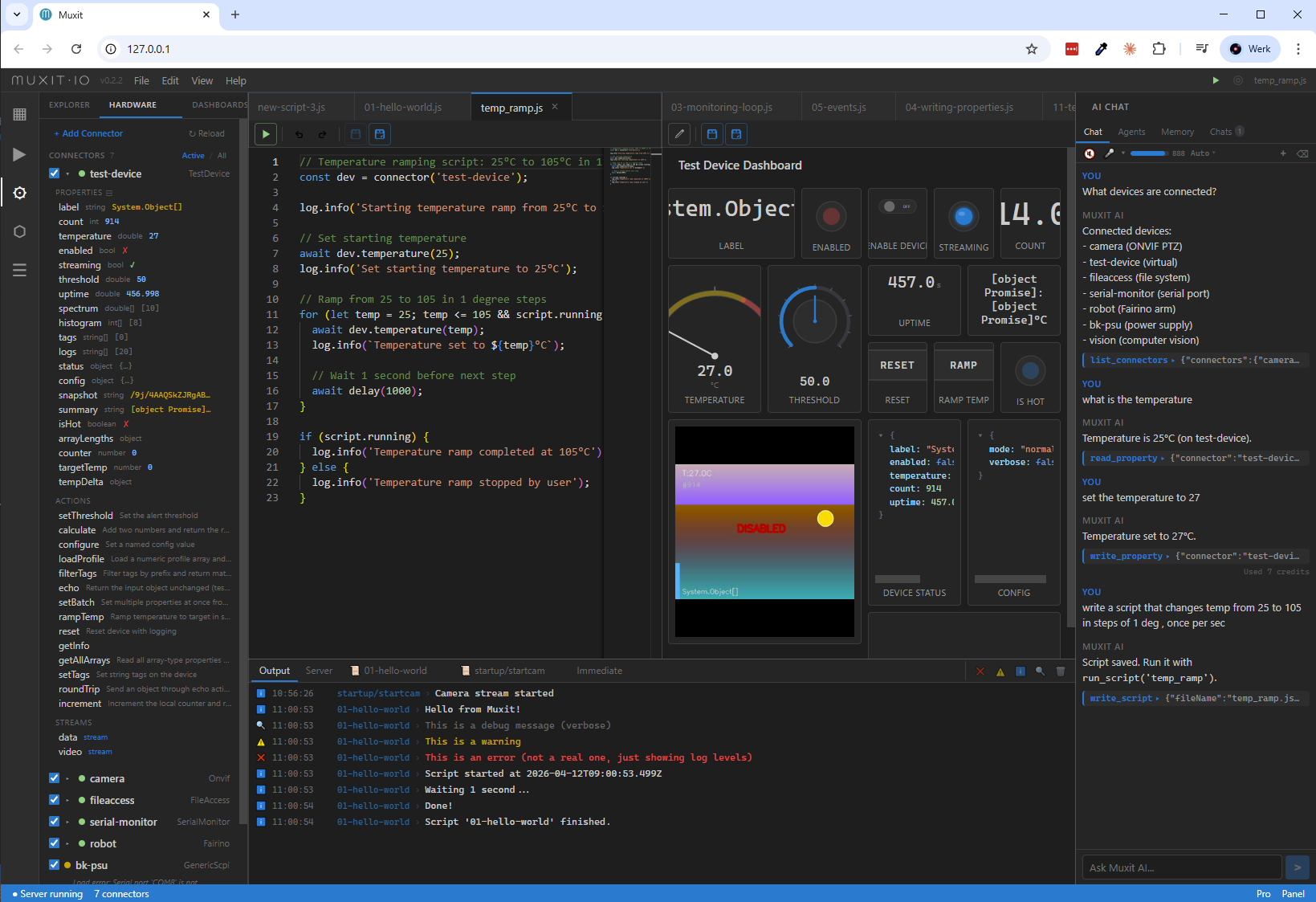
Every connector with its live properties. Read values update in real-time; writable fields are editable inline. Drag any property onto a script or dashboard — Muxit inserts the right code or widget automatically.
The center workspace holds both your automation scripts and live dashboards. Switch between code and drag-and-drop control panels in the same tab. Autocomplete knows every connected device.
Ask questions about your hardware or have the AI drive it directly. Tool calls are visible and gated — you stay in control.
Muxit sits between your physical hardware and your software. Devices talk their native protocols — Muxit translates everything into clean JavaScript.
Robots, power supplies, spectrometers, sensors, ESP32 — anything with a port or IP address.
Lightweight adapters that speak the device's native protocol. JavaScript modules, definition files, or compiled plugins.
Wrap a driver with your config, custom methods, and computed properties — giving each device a friendly name and API.
Scripts, dashboards, external apps, or AI — all using the same natural JavaScript API.
Drivers speak the device's native protocol. Connectors wrap a driver with your configuration and custom methods — giving each device a friendly name and API. You write connectors, the community builds drivers.
From simple serial devices to complex robotic systems — one platform, one API, one language.
Wrap hardware drivers with friendly APIs. Custom methods, computed properties, and reactive polling out of the box.
Sandboxed JavaScript automation with natural syntax. Control, measure, and coordinate across all connected devices.
Drag-and-drop layouts with live gauges, charts, sliders, buttons, terminals, and video streams. All real-time.
Control your lab with natural language. Chat, voice commands, or autonomous agents with configurable safety gates.
Build drivers in JavaScript or C#. From simple serial commands to complex vendor SDKs. A 20-line JS file is enough.
Access your lab from anywhere — LAN, VPN, or secure tunnel. Control equipment from your laptop, phone, or another city.
No core modification needed. Pick the driver format that matches your complexity.
Write a driver in plain JavaScript. Export get, set, execute — done. Community-driven, open, and fast to build.
.driver.js
Text files listing commands and properties. No code needed — just define your instrument's protocol in a structured format.
.scpi · .serial
For instruments requiring native vendor SDKs. Premium drivers built by the Muxit team with full hardware integration.
.dll
A complete JavaScript driver — 20 lines:
export default { meta: { name: "SimplePSU", properties: { voltage: { type: "number", access: "rw", unit: "V" }, current: { type: "number", access: "r", unit: "A" }, }, actions: { reset: { description: "Reset to defaults" } }, }, async init(config) { this.transport = createSerialTransport( config.port, { baudRate: 9600 } ); }, async get(prop) { return await this.transport.query(`${prop}?`); }, async set(prop, val) { await this.transport.send(`${prop} ${val}`); }, async execute(action) { await this.transport.send("*RST"); }, };
Not just a chat window — a full AI agent framework with tool-calling, safety gates, and hardware awareness.
Native Model Context Protocol integration. Claude Code and Claude Desktop connect directly — no API key needed.
"Set the voltage to 12V", "Move the robot up 5 centimeters", "Run the calibration sequence" — plain English, real hardware.
Hands-free operation with wake word detection. Say "Muxit, read the temperature" while your hands are on the bench.
AI agents chain multiple tool calls for complex tasks. Configurable safety gates — confirm mode or trust mode, your choice.
"Make a script that scans the spectrometer every 10 seconds" — AI generates runnable code from natural language.
x: 340.2, y: 120.5, z: 85.0 with the gripper open. The joint angles are within normal range.z: 135.0 and closed the gripper. Force feedback reads 12N — good grip.From automated test benches to interactive art installations — if it has a port, Muxit can talk to it.
Automated measurement rigs, data logging, instrument coordination. Run overnight test sequences with a 10-line script.
Collaborative robots integrated with sensors, cameras, and tools. Coordinate pick-and-place with measurement in one script.
Responsive installations connecting sensors to lights, motors, and sound. React to visitors in real-time with live dashboards.
ESP32, Arduino, and MQTT devices on real-time dashboards. Bridge the gap between cheap sensors and serious data logging.
No await, no callbacks, no boilerplate. Read properties directly, write with assignment. That's it.
Log measurements to file
const psu = connector("psu"); const file = connector("file-access"); while (script.running) { const v = psu.measured_voltage; const i = psu.measured_current; file.appendLine({ path: "log.csv", text: `${timestamp()},${v},${i}` }); delay(1000); }
Safety interlock between devices
const sensor = connector("thermocouple"); const psu = connector("psu"); while (script.running) { if (sensor.temperature > 60) { psu.voltage = 0; log.warn("Over-temp! PSU disabled."); } delay(500); }
AI vision inspection
const cam = connector("webcam"); const snap = cam.snapshot; const result = ai( "Is the solder joint good?", snap ); log.info(result);
Voltage ramp with monitoring
const psu = connector("psu"); psu.output = true; for (let v = 0; v <= 12; v += 0.5) { psu.voltage = v; log.info(`${v}V → ${psu.measured_current}A`); delay(200); }
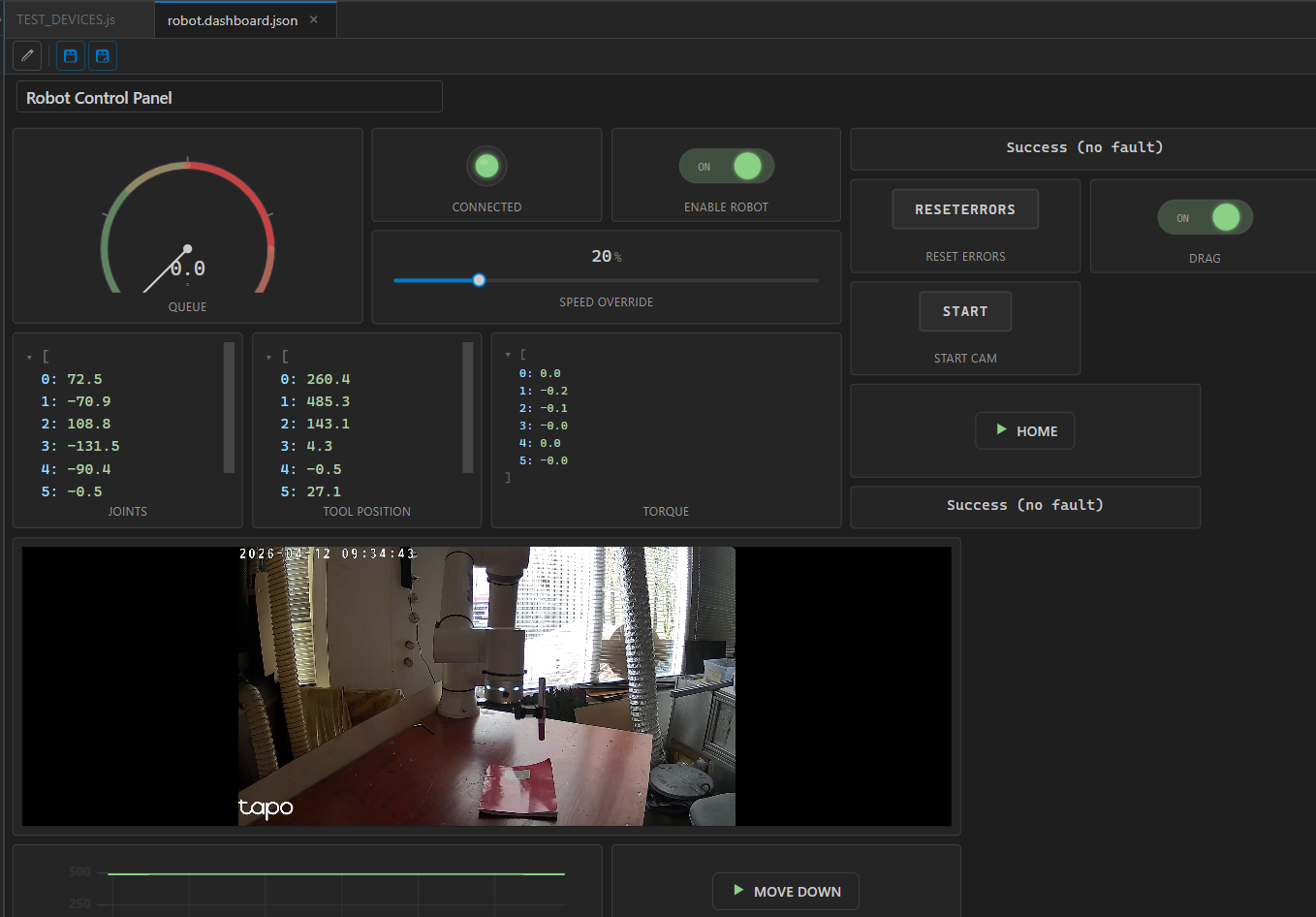
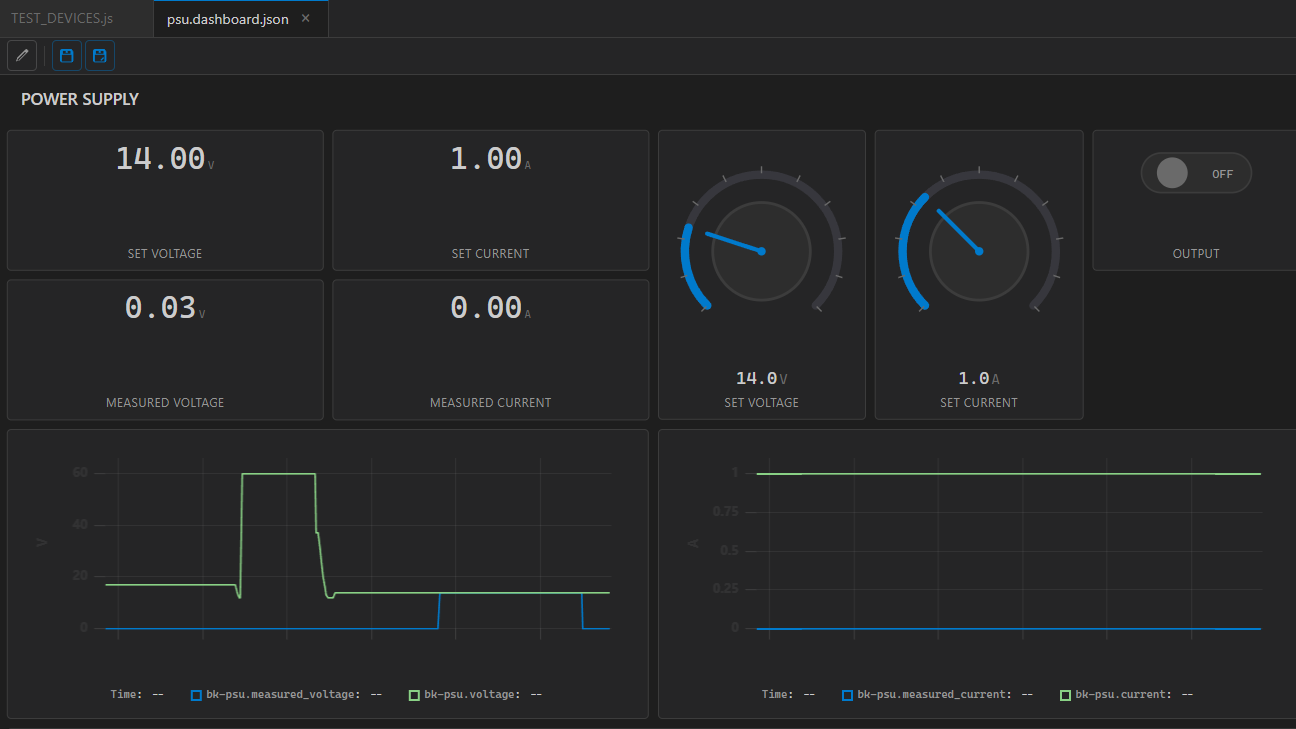
Build live control panels from widgets. Bind them to device properties — they update automatically.
Drag properties from the hardware panel onto a dashboard to create widgets. Drag scripts onto the grid for start/stop controls. Everything is JSON — version control friendly.
Muxit is in active development. Join the waitlist for early access and updates.
No spam. Unsubscribe anytime.